WindowsGeneral guide10 October 20265 min read
Window U-values and low-E glass: how to read a specification.
Read window quotes confidently: distinguish glass and whole-window U-values, low-E coatings, solar gain, daylight, air leakage and installation performance.

A useful window specification tells you what was measured, for which product configuration, in which units—and how that product will be installed. Terms such as low-E, double glazed or thermally broken describe features. They do not, by themselves, establish the performance of the complete installed opening.
Use the following questions when reading a quotation for a new build or window replacement. They apply across regions; the final performance targets should suit the building and local design conditions.
Start with U-value or U-factor
U-value describes heat transfer through a construction under stated conditions. For otherwise comparable values, a lower number indicates less heat transfer. In metric specifications, it is commonly expressed in W/m²K.
Some documents use U-factor and different units. Do not compare the numbers until the units and test basis are clear. Ask the supplier to present comparable results rather than relying on an online conversion without checking what the original figure describes.
The National Fenestration Rating Council’s ratings information separates U-factor from solar gain, daylight and air-leakage measures. Its certification and units are specific to its system; it is not a local requirement that every Indian window must carry that label.
Distinguish the glass from the whole window
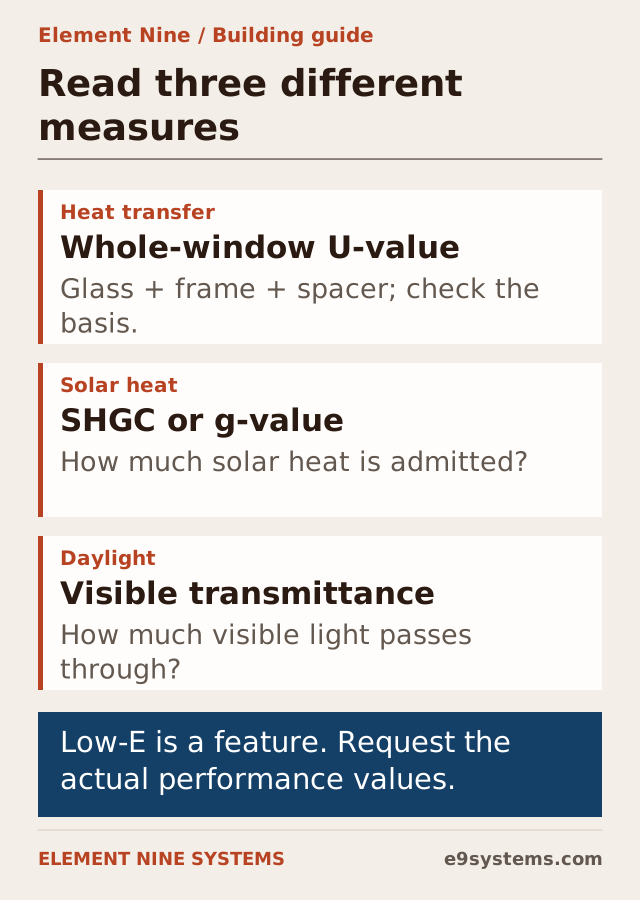
The centre of an insulated glass unit may perform differently from the frame and glass edge. A whole-window result accounts for the complete product under the stated rating method.
You may see notation such as Ug for glazing, Uf for frame and Uw for the whole window in some specification systems. Ask the supplier to define the notation it uses. A glass-only result should not be presented as though it describes the entire opening.
Confirm whether the declared value applies to the quoted size, opening type and glazing configuration, or to a reference product. Differences in frame proportion and construction can matter when comparing small and large openings.

Understand low-E as a feature, not a complete rating
Low-emissivity coatings affect radiative heat transfer through glass. The US Department of Energy’s window guidance explains that low-E products can be designed with different solar-gain characteristics.
Ask which coating is included and what thermal, solar and daylight data accompany it. Two low-E products need not have identical behaviour. Colour, reflectivity and visible appearance may also matter to the owner or architect.
Request the exact insulated-unit build-up, including panes, cavities, declared gas fill where applicable and spacer specification. Do not rely on the brochure photograph of a different product tier.
Keep solar gain and daylight separate
Solar heat gain coefficient, often abbreviated SHGC, describes the fraction of incident solar energy admitted through the product under its rating method. A declared g-value or solar factor may appear in other systems. Ask which basis is used when comparing them.
Visible transmittance describes daylight transmission. A product that limits solar gain may also change how bright the room feels, depending on its construction. Lower solar gain is not automatically the goal for every room; orientation, shading, winter benefit and overheating risk need a combined assessment.
Use room names and directions on the window schedule. A north-facing bedroom and a sun-exposed living space should not receive a specification simply because all windows have been grouped under one price.
Ask for the missing measures
| Measure or detail | What it helps you understand |
|---|---|
| Whole-window thermal result | Heat transfer through the rated product |
| Solar gain | Sun-derived heat entering through the window |
| Visible transmittance | Daylight transmission |
| Air-leakage data | Leakage through the tested product at stated conditions |
| Water and wind performance | Resistance under the declared test conditions |
| Acoustic result | Sound performance of the tested configuration |
| Installation detail | The connection between the product and the building |
Check the test method, conditions, product size and configuration. A number without that context can be difficult to compare meaningfully. Do not treat a thermal rating as evidence of acoustic, structural or weather resistance.
Review the frame and installation joint
For a metal frame, ask how any thermal break is incorporated and what declared whole-product performance results from it. For other frame materials, still request complete performance data rather than assuming the material name proves the result.
The installation proposal should identify fixing, perimeter insulation, internal air sealing, external weather protection and sill drainage. Confirm how the frame sits relative to any wall insulation, and how reveals and lintels are treated.
A tested window’s product rating does not certify the workmanship at your site. Ask for installation inspections and photographs before the joint is hidden by trim or plaster.
Build a comparison sheet before ordering
Place quotations side by side using the same opening schedule. Add performance evidence, installation scope, removal and making good, hardware, service arrangements and warranty exclusions.
Where a supplier cannot provide a requested figure, record the missing information. That does not establish failure, but it prevents unsupported claims from becoming assumptions in the building design.
For the pane-count decision in a cold-region project, see double versus triple glazing for Kashmir. For commercial scope comparisons, use our BOQ guide.
Does a better glass U-value guarantee a warmer room?
It can be part of an improvement, but the frame, installation, surrounding construction, ventilation and heating also affect the room. Compare the complete assembly and its place in the building.
Is a “low-E window” enough information for a quote?
No. Ask for the product configuration, declared performance, frame, hardware and installation detail. The phrase describes one feature of a larger system.
Bring the data to the design conversation
Send the window schedule, supplier sheets, plans or opening photographs and the comfort priorities for each room. Element Nine Systems can discuss window specification and installation alongside the envelope details that make the performance relevant to your home.